From dopamine-driven rewards to AI-powered recommendations, technology companies have learned how to capture our attention. But how much do they really know about influencing the human brain?
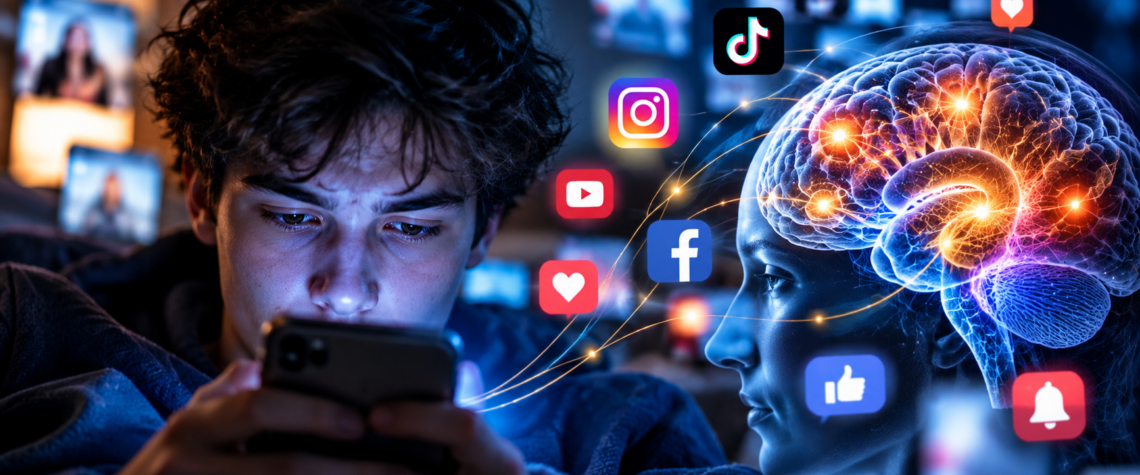
You pick up your phone to check a message. A few minutes later, you are watching a video you never intended to see. Then another appears. And another. By the time you look at the clock, half an hour has disappeared. It is an experience familiar to millions of smartphone users. But what appears to be an innocent distraction raises a deeper question: Are we freely choosing how much time to spend on our devices, or are increasingly sophisticated technologies influencing those decisions? Behind the seemingly effortless experience of scrolling through social media lies a complex combination of behavioral psychology, artificial intelligence, and knowledge about how the human brain responds to rewards, novelty, and social recognition. Technology companies have become remarkably effective at predicting what attracts our attention. The question is whether their ability to influence our behavior is advancing faster than our ability to understand and control it.
The Brain’s Reward System
To understand why smartphones can be so difficult to put down, it helps to examine how the brain responds to rewarding experiences. Dopamine, a neurotransmitter involved in motivation, learning, and reward processing, plays an important role in reinforcing behaviors. Contrary to a popular misconception, dopamine is not simply a chemical that produces pleasure. It also helps the brain learn which experiences are worth pursuing. Consider what happens when someone posts a photograph on social media.
The person may receive a few likes, a flattering comment, or perhaps no reaction at all. The uncertainty surrounding that response can create anticipation and encourage repeated checking. Psychologists have long studied how unpredictable rewards can reinforce behavior. Digital platforms can incorporate similar principles through notifications, social feedback, and continually changing content.
A 2025 systematic review examining the effects of social media likes on brain activity identified responses in regions associated with reward processing and social evaluation. The findings do not establish that receiving likes is equivalent to drug addiction. They do, however, demonstrate that digital social feedback interacts with neural systems involved in motivation and reward.
The Invisible Architecture of Attention
Many of the features people now consider normal were deliberate design choices. Infinite scrolling removes the natural stopping points that once separated one page of information from another. Autoplay eliminates the need to decide whether to watch another video. Notifications encourage users to return, while personalized recommendations continuously offer material selected to match their interests.
Individually, these features may seem harmless. Together, they can create an environment in which continuing to engage requires less effort than stopping.
The American Psychological Association has warned that features such as endless scrolling and unrestricted engagement can present particular challenges for adolescents, whose abilities to regulate attention and behavior are still developing. The organization has also raised concerns about notifications that interrupt concentration and encourage repeated checking.
These design techniques do not literally control the nervous system. Instead, they shape the environment in which people make decisions, sometimes taking advantage of predictable psychological tendencies. That distinction is essential. Influence is not the same as mind control, but influence can still become ethically troubling when it undermines a person’s ability to make deliberate choices.
When Artificial Intelligence Learns What Keeps You Watching
Artificial intelligence has made the attention economy considerably more sophisticated. Traditional media organizations once relied on editors to decide which stories or programs audiences would see. Digital platforms can now use machine learning to personalize content for individual users. YouTube, for example, has publicly explained that its recommendation system considers signals including clicks, viewing time, likes, dislikes, and user satisfaction surveys. These signals help algorithms predict which videos a particular person might want to watch next.
The technology can be useful. It helps people discover educational resources, entertainment, and information that might otherwise remain hidden. But the same predictive capabilities create an uncomfortable possibility: an algorithm that learns what interests someone may also learn what repeatedly captures that person’s attention, even when continued engagement is not in their long-term interest.
The distinction between what users enjoy and what benefits them is not always clear. A person may watch an hour of emotionally upsetting content without feeling satisfied afterward. Yet their behavior can still provide data that an algorithm uses to refine future recommendations. YouTube says its system incorporates measures of satisfaction rather than optimizing exclusively for viewing time. Nevertheless, the broader tension between user welfare and commercial incentives remains an important subject of public debate.
What Neuroscience Is Discovering About Problematic Smartphone Use
Scientific research has begun examining whether excessive or compulsive smartphone use is associated with measurable differences in brain activity. A systematic review published in October 2025 in Progress in Neuro-Psychopharmacology and Biological Psychiatry examined neuroimaging studies of problematic smartphone use.
The researchers reported associations involving neural circuits related to reward processing, executive control, and responses to smartphone-related cues. These findings suggest that problematic smartphone use involves interactions among motivation, emotional responses, learned habits, and self-regulation. However, the research has important limitations.
Brain imaging studies cannot automatically establish whether smartphone use caused observed differences or whether preexisting individual characteristics contributed to excessive use. Nor do they demonstrate that ordinary smartphone users experience permanent neurological damage.
The evidence supports concern about compulsive patterns of use, but not sensational claims that technology companies have discovered how to take direct control of the human brain.
Are Technology Companies Deliberately Manipulating Users?
The question of manipulation extends beyond neuroscience. In 2022, the Federal Trade Commission published a report examining deceptive digital design techniques commonly known as dark patterns. These practices can include misleading interfaces, concealed information, confusing cancellation procedures, and design choices that steer consumers toward decisions they might not otherwise make.
A subsequent international review announced in 2024 examined 642 subscription websites and mobile applications. Investigators found that nearly 76 percent employed at least one possible dark pattern. The review did not determine that all those practices were illegal. Nevertheless, its findings demonstrated how widespread potentially manipulative design techniques had become.
Dark patterns are not necessarily based on neuroscience research. Many rely on well-established principles of consumer psychology and behavioral economics. But they raise the same fundamental issue: when companies understand human decision-making better than their customers understand the systems influencing them, the balance of power becomes increasingly unequal.
Why Are Technology Companies Interested in Neuroscientists?
Major technology companies employ neuroscientists, cognitive scientists, psychologists, and medical researchers for a variety of purposes. Some investigate artificial intelligence and human cognition. Others work on medical imaging, neurological diseases, accessibility technologies, or brain-inspired computing.
Their expertise can also contribute to research on perception, learning, human-computer interaction, and behavior. But there is an important distinction between employing neuroscientists and employing them specifically to make digital products addictive.
Publicly available evidence does not establish that Google’s recruitment of neurologists for healthcare AI is part of a coordinated effort to manipulate smartphone users’ nervous systems. Making that allegation would require direct evidence, such as internal research objectives, documented product-development practices, or testimony connecting particular scientific work to deliberately exploitative engagement strategies.
What is demonstrable is that digital companies already use extensive behavioral data and machine learning to understand and predict user engagement. Whether those capabilities are used responsibly depends on the objectives companies pursue, the safeguards they adopt, and the degree of transparency they provide.
The Next Frontier: AI That Understands Our Vulnerabilities
The emergence of increasingly capable AI introduces a new dimension to the debate. Future systems may become better at recognizing patterns associated with emotional responses, changing interests, and moments when users are particularly receptive to certain kinds of content.
These capabilities could support valuable applications, including more accessible interfaces, personalized education, and digital tools that help people manage their time. They could also create opportunities for more intrusive forms of behavioral influence.
Imagine a recommendation system that becomes exceptionally effective at identifying the types of content a particular user finds difficult to ignore. Would its purpose be to help that person make better choices, or to keep the person engaged for as long as possible? The answer would depend not simply on the intelligence of the system but on the incentives governing its design.
This is not proof that any particular company has already developed a system capable of reliably detecting and exploiting an individual’s neurological vulnerabilities. It is a foreseeable ethical concern as AI-based personalization becomes more sophisticated.
Who Controls Whom?
Smartphones have transformed modern life. They connect families, provide access to knowledge, support businesses, and make services available that would have seemed extraordinary only a generation ago. The problem is not that digital technology captures our attention. Every newspaper, television program, book, and advertisement competes for attention in some way.
The difference is that modern digital platforms can observe behavior continuously, adapt their offerings automatically, and personalize experiences on a scale traditional media could never achieve. That power creates responsibilities extending beyond keeping users entertained.
Researchers, regulators, and technology companies increasingly face questions about transparency, meaningful user choice, and the protection of people vulnerable to compulsive engagement.
The ultimate challenge is not to eliminate persuasive technology. It is to ensure that persuasion does not become exploitation. Artificial intelligence may soon understand more about our digital habits than we consciously recognize ourselves. The question society must answer is whether that knowledge will help us exercise greater control over our lives—or gradually make it harder to put our phones down.
……………………………
These investigations and documents support the main arguments: